

Commentary
Gwendolyn Sasse
{
  "authors": [
    "Gwendolyn Sasse"
  ],
  "type": "commentary",
  "blog": "Strategic Europe",
  "centerAffiliationAll": "",
  "centers": [
    "Carnegie Endowment for International Peace",
    "Carnegie Europe"
  ],
  "collections": [
    "Europe’s Eastern Neighborhood"
  ],
  "englishNewsletterAll": "",
  "nonEnglishNewsletterAll": "",
  "primaryCenter": "Carnegie Europe",
  "programAffiliation": "",
  "programs": [],
  "projects": [],
  "regions": [
    "Europe",
    "Eastern Europe",
    "Ukraine"
  ],
  "topics": [
    "EU"
  ]
}
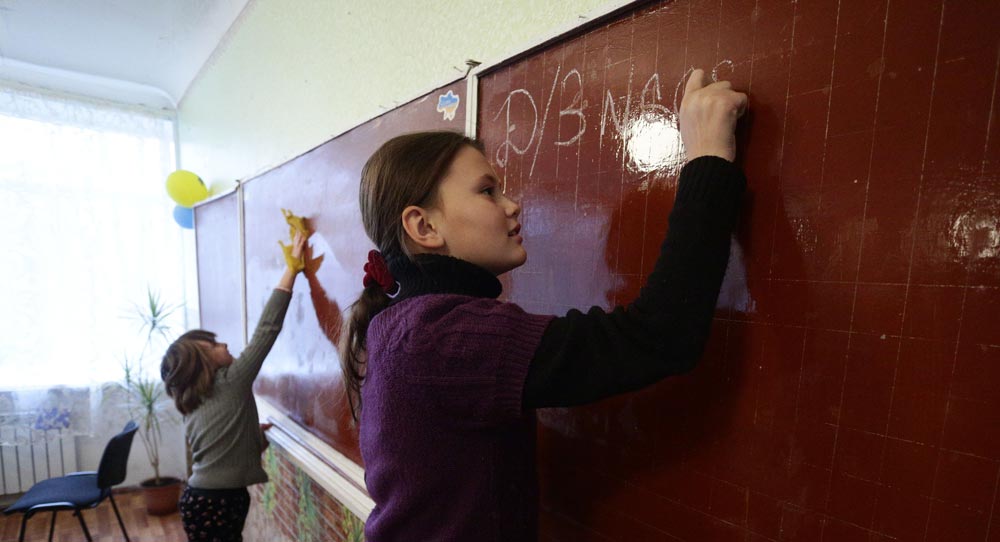
Source: Getty
Endorsing bilingualism in education would be the inspired and progressive option for the Ukrainian leadership.
On September 25, Ukrainian President Petro Poroshenko signed a new law on education. The law, which is to be implemented gradually from September 2018 until September 2020, had been approved by parliament in early September, but the draft was changed at the last moment. The language provisions contained in the law make it controversial both inside Ukraine and in neighboring states, as it envisages that all secondary education will be taught in Ukrainian.
Beyond the language issue, the law lays the groundwork for a comprehensive school reform, including an extension of school education from 11 to 12 years and changes in the overall teaching program. It is presented as an attempt to align Ukraine’s school system more closely with European standards. The language controversy, however, has sidelined the discussion about the need for education reform more generally.
Instruction in minority languages at kindergarten and primary school level remains unaffected by the law. At secondary level, however, national minority languages are now being reduced to special lessons. One reason is that Ukrainian politicians and experts have underlined the importance of making the next generation of individuals belonging to national minorities competitive for the Ukraine-wide job market. The discussion so far has been focused on Hungarians, Romanians, Russians, and other minorities. However, the political undercurrent of the wider project is obvious: to further strengthen the status of the Ukrainian language vis-à-vis Russian. Here the law on education follows on from a law signed by the president in June, which increases the mandatory share of Ukrainian-language content on national and regional television, and precedes the as yet pending language law.
Language issues are often misunderstood by outside observers of Ukraine. Instead of clear-cut ethnolinguistic lines, everyday life in southeastern Ukraine is characterized by the use of both Russian and Ukrainian. Bilingualism, or the coexistence of both languages, is the norm. In view of this, successive Ukrainian presidents and governments since independence from the Soviet Union in 1991 have been prudent to adopt a more incremental approach to “Ukrainization.”
At the time of the last Ukrainian census in 2001, fewer than 30 percent declared Russian their native language, a figure that has decreased over time. “Native language” is, above all, an identity marker rather than a measure of language use. In surveys that also allow for the dual category “Russian and Ukrainian,” which is closer to the reality of many in Ukraine, “Russian” was chosen by about 22 percent in 2014, and 13 percent in 2017, while the mixed category has remained fairly stable around 17 to 18 percent.
While Russia’s criticism of the law did not come as a surprise, the speed and harshness with which parliaments, governments, journalists, and analysts in Hungary, Romania, Poland, Bulgaria, Greece, and Moldova reacted had not been anticipated in Ukraine.
Romanian government officials see themselves as speaking on behalf of the approximately 150,000 Romanians and 250,000 Moldovans living in Ukraine. The Romanian parliament’s declaration criticizing the law includes a warning that Ukraine cannot progress on its way toward EU integration without demonstrating respect for national minorities. The Romanian President Klaus Iohannis even cancelled a trip to Ukraine before the law was signed. The response from Budapest was even more explicit. Hungarian Foreign Minister Péter Szijjártó openly threatened Ukraine by saying that Hungary would not support Kyiv’s attempt at further EU integration if the law is implemented. About 150,000 Hungarians live in Zakarpattya Oblast in western Ukraine.
The Russian State Duma and Federation Council adopted a resolution on September 27, condemning the law as infringing upon the rights of the Russophones in Ukraine. Interestingly, Russia is not disputing the labeling of Russians or Russophones in Ukraine as a “national minority” anymore. Instead, Moscow’s key objective is to tarnish Ukraine’s image in Europe as a country unwilling to adhere to the union’s values and norms.
Critics call upon the UN, the OSCE, and the Council of Europe to bring the law in line with international standards. The protection of national minorities is ultimately a sovereignty issue and varies considerably across the EU, despite the fact that the principle is part of the EU conditionality for membership and enshrined in EU law. While the Ukrainian law does not contradict EU law per se and is not an exception when compared to EU member state practice, it nevertheless goes against the spirit of the minority protection principle enshrined in international and European conventions.
Given Ukraine’s current state of affairs, it can hardly be in Kyiv’s interest to alienate a number of EU member states when the country needs their support for its ongoing difficult reform process and attempts at conflict-resolution. Further escalation of Ukraine-Russia relations can also only limit the scope for conflict-resolution. Rather than taking these political risks, endorsing bilingualism in education and public life more generally would be the inspired and progressive option for the Ukrainian leadership to choose. This does not preclude an obligation for pupils and students to become fluent in the state language alongside their national language. By adopting such an approach, Ukraine would stand a better chance of defusing political tensions within and vis-à-vis its neighbors, and it could also set an example for many EU member states. What better way for Ukraine to prove its “European” credentials?
Gwendolyn Sasse is a non-resident senior fellow at Carnegie Europe and the director of the Centre for East European and International Studies (ZOiS) in Berlin.
Nonresident Senior Fellow, Carnegie Europe
Sasse is a nonresident senior fellow at Carnegie Europe. Her research focuses on Eastern Europe, with a particular focus on Ukrainian politics and society, EU enlargement, and comparative democratization.
Recent Work
Gwendolyn Sasse
Gwendolyn Sasse
Carnegie does not take institutional positions on public policy issues; the views represented herein are those of the author(s) and do not necessarily reflect the views of Carnegie, its staff, or its trustees.
The EU is structurally incapable of reacting to today’s foreign policy crises. The union must fold the EEAS into the European Commission and create a security council better prepared to take action on the global stage.

Stefan Lehne
The war in Ukraine is costing Russia its leverage overseas. Across the South Caucasus and Middle East, this presents an opportunity for Europe to pick up the pieces and claim its own sphere of influence.

William Dixon, Maksym Beznosiuk
The war in Iran proves the United States is now a destabilizing actor for Europe and the Arab Gulf. From protect their economies and energy supplies to safeguarding their territorial integrity, both regions have much to gain from forming a new kind of partnership together.

Rym Momtaz
French President Emmanuel Macron has unveiled his country’s new nuclear doctrine. Are the changes he has made enough to reassure France’s European partners in the current geopolitical context?
Rym Momtaz, ed.
European reactions to the war in Iran have lost sight of wider political dynamics. The EU must position itself for the next phase of the crisis without giving up on its principles.

Richard Youngs