

Commentary
Rym Momtaz, ed.
{
  "authors": [
    "Rym Momtaz"
  ],
  "type": "commentary",
  "blog": "Strategic Europe",
  "centerAffiliationAll": "",
  "centers": [
    "Carnegie Endowment for International Peace",
    "Carnegie Europe"
  ],
  "englishNewsletterAll": "",
  "nonEnglishNewsletterAll": "",
  "primaryCenter": "Carnegie Europe",
  "programAffiliation": "",
  "regions": [
    "Europe",
    "United Kingdom",
    "France",
    "Germany"
  ],
  "topics": [
    "Defense",
    "EU",
    "Foreign Policy",
    "Security"
  ]
}
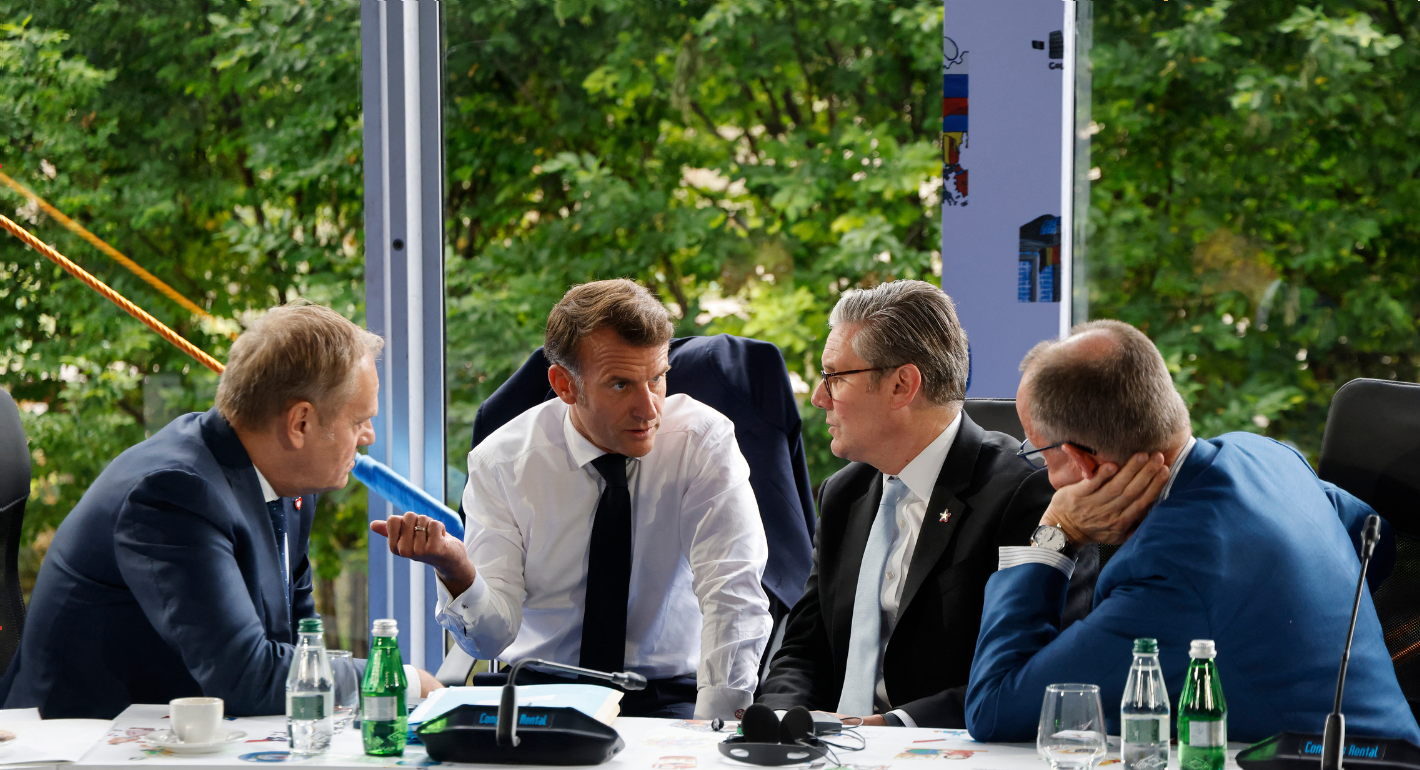
Source: Getty
Leaning into a multispeed Europe that includes the UK is the way Europeans don’t get relegated to suffering what they must, while the mighty United States and China do what they want.
There is safety in numbers, or so the popular saying goes. And EU institutions have taken it to heart. The thinking is: The larger the European bloc, the more powerful it is, and the better equipped it is to confront geopolitical and geoeconomic earthquake underway.
The obsession with unity is real in Brussels and in some capitals. Any hint of disunity taken as proof of the dreaded decline the EU is constantly accused of.
The twenty-seven EU members have certainly defied many expectations since Russia’s full-scale invasion of Ukraine. Along with the European Commission, they have come up with creative workarounds for their divisions to impose sanctions, raise funds, and finance military aid—even if it has often been a laborious and lengthy process.
But in light of the current epochal shifts on the global stage, the best chance Brussels has of preserving what global power it does have is by leaning into its divisions to gain margins of maneuver. It cannot keep prioritizing consensus among the twenty-seven, settling for the lower tiers of urgent action needed for its defense, economic strike force, and energy security.
The idea of a multispeed Europe isn’t new, but it has never been more vital.
A core group of more forward-leaning member states has emerged through the so-called coalition of the willing on Ukraine. The twelve countries that form it should be able to forge ahead together and faster than the EU as a whole. They could be the scout cruisers for the rest of the union, lighting the way while the others catch up.
This group has developed a coherence by virtue of their geography and history. The Nordic-Baltic Eight—Denmark, Estonia, Finland, Iceland, Latvia, Lithuania, Norway, and Sweden—have had to shed some of their taboos when it comes to defense planning outside of NATO and common defense funding. They also share an assessment of the urgency of the Russian threat that is higher than most others in less exposed geographic locations.
France, the UK, and in some respects Germany and Poland complete this group. They bring the essential heft and capabilities without which a core group would not have enough firepower.
Together these countries gather a critical mass of positive demography, political willpower, economic and military strength, as well as energy and tech resources to fire on all cylinders in the current geopolitical moment.
The focus of such a nucleus must be defense first and foremost. But not just in terms of raising budgets and massively investing in production lines—as vital as those are. This group must also forge a new common strategic culture built around the readiness to carry out military operations on their own. A rekindling of the practice of hard power.
That still eludes them. It took them nearly two years—including a full year of brutally adversarial diplomacy by U.S. President Donald Trump and his wider team—to finally set up an operational command center and draw up deployment plans. What they still haven’t managed to do is fully graduate to geopolitical adulthood; in other words, the ability to envision taking military action not only without the United States but also in a way Washington may not fully endorse.
The second priority should be a considerably more coordinated foreign policy that includes strategic communications and informational warfare. The E3 group of France, Germany, and the UK provides only a skeleton to build on, for even those countries no longer wield enough individual power to be normative players. By acting more in lockstep and integrating the value added by the Nordic-Baltic Eight, in particular in the digital and cyber arenas, a more formidable Europe could emerge.
The first challenge will be to overcome reservations about integrating the UK post-Brexit. London’s return would not be a reward for Brexit—quite the contrary—it would be a constant reminder of just how central and indispensable a European framework has become.
The second challenge will be to overcome a knee-jerk recoil at diluting some sovereign prerogatives long considered the sole remit of national governments. Of what worth is a narrow national sovereignty if Europeans are to become individual pawns in a world they can no longer shape or drive?
Once these two major taboos are dissolved, the group can more efficiently tackle the existing—but decreasing—divergences it has over more ideological and technical issues. These include their assessment of just how deep the schism with the United States has truly become, and how to deal with it. How to associate the UK to EU funding facilities, how to create the long-awaited capital markets union, and how deep of a fiscal union is desirable can similarly be explored. And there are other questions to ask: On how widely across sectors a European preference should be applied, and on how to independently produce energy in a sustainable enough way to fuel the next technological leap.
Significant as they may be, these divergences are not insurmountable in a reduced, more agile format.
Another grouping may well have to emerge in parallel to this one. Likeminded, capable, and willing member states can move forward on supercharging the EU’s economic firepower by deepening the single market, completing the capital markets union and banking union, and consolidating industry. The formation of specialized subgroups within the whole should no longer be seen as a negative to avoid, but rather as a necessary flexibility without which the European project cannot survive.
It is time for leaders to meet the moment with the willpower, flexibility, and speed commensurate with the upending of the global security architecture that the EU was built on. This kind of two-tier Europe is not a silver bullet by any means, but in the current context, it is the best chance Europeans have of retaining some control over their destiny in a world set to be unruly for years to come.
Subscribe to Strategic Europe, delivered to you weekdays!

Editor in Chief, Strategic Europe
Rym Momtaz is the editor in chief of Carnegie Europe’s blog Strategic Europe. A multiple Emmy award-winning journalist-turned-analyst, she specializes in Europe and the Middle East and the interplay between those two spaces.
Recent Work
Rym Momtaz, ed.
Rym Momtaz
Carnegie does not take institutional positions on public policy issues; the views represented herein are those of the author(s) and do not necessarily reflect the views of Carnegie, its staff, or its trustees.
The far right failed to win big in France’s municipal elections. But that’s not good news for the country’s left wing, which remained disunited while the broader right consolidated its momentum ahead of the 2027 presidential race.
Catherine Fieschi
Donald Trump has demanded that European allies send ships to the Strait of Hormuz while his war of choice in Iran rages on. He has constantly berated NATO while the alliance’s secretary-general has emphatically supported him.
Rym Momtaz, ed.
The EU is structurally incapable of reacting to today’s foreign policy crises. The union must fold the EEAS into the European Commission and create a security council better prepared to take action on the global stage.

Stefan Lehne
The war in Ukraine is costing Russia its leverage overseas. Across the South Caucasus and Middle East, this presents an opportunity for Europe to pick up the pieces and claim its own sphere of influence.


William Dixon, Maksym Beznosiuk
The war in Iran proves the United States is now a destabilizing actor for Europe and the Arab Gulf. From protect their economies and energy supplies to safeguarding their territorial integrity, both regions have much to gain from forming a new kind of partnership together.
Rym Momtaz