

Commentary
Andrey Pertsev
{
  "authors": [
    "Andrey Pertsev"
  ],
  "type": "commentary",
  "blog": "Carnegie Politika",
  "centerAffiliationAll": "",
  "centers": [
    "Carnegie Endowment for International Peace",
    "Carnegie Russia Eurasia Center"
  ],
  "englishNewsletterAll": "",
  "nonEnglishNewsletterAll": "",
  "primaryCenter": "Carnegie Russia Eurasia Center",
  "programAffiliation": "",
  "regions": [
    "Russia"
  ],
  "topics": [
    "Domestic Politics",
    "Civil Society",
    "Political Reform"
  ]
}
Source: Getty
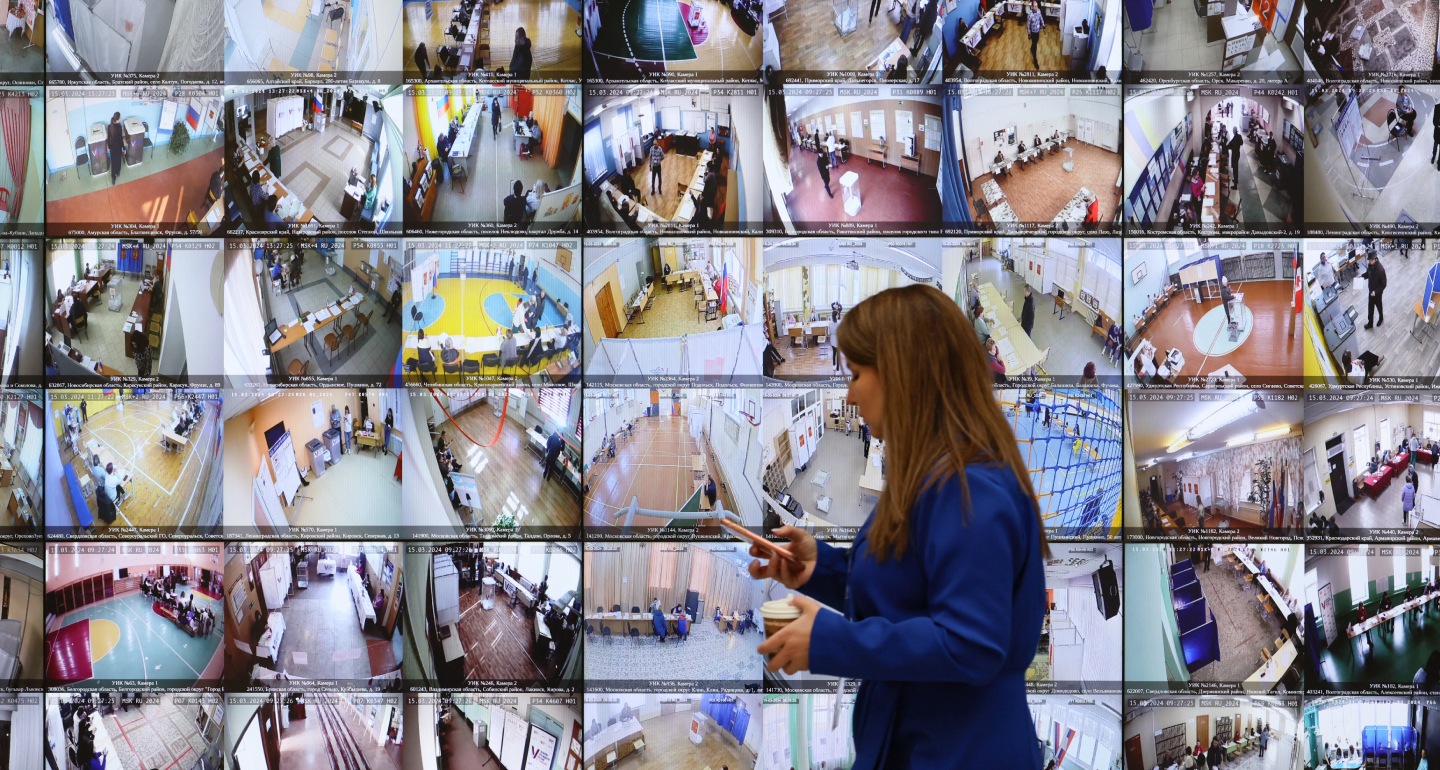
The use of technology to mobilize Russians to vote—a system tied to the relative material well-being of the electorate, its high dependence on the state, and a far-reaching system of digital control—is breaking down.
During the quarter century for which Vladimir Putin has ruled Russia, the Kremlin’s domestic policy bloc has built a system of “corporate mobilization” to guarantee the required election results. At its core are administrative resources: the ability to force all Russians who are directly or indirectly dependent on the state to vote.
Now, however, mounting economic problems are reducing the extent to which groups of voters dependent on the state can be controlled. At the same time, through new restrictions on the internet and digital communications, the government itself is dismantling the infrastructure upon which corporate mobilization was built. As a result, the Kremlin faces a difficult choice: drastically reduce key performance indicators (KPIs) for the State Duma elections on September 20, or expand vote rigging to unprecedented levels.
Over the years of Putin’s rule, the Kremlin’s domestic policy machine had shifted from cultivating genuine support for the regime to ensuring voter turnout. Whether people showed up under pressure or not did not matter. The important thing was that the ballot boxes were full with votes for the government.
This system of “corporate mobilization” gradually expanded to cover not only public sector workers, but also employees of all businesses loyal to the state. For the convenience of officials and corporate management, databases were compiled of everyone who was in any way dependent on the state. Digitization, the spread of messaging apps, and electronic voting significantly simplified and standardized the electoral coercion process. By the start of the full-scale war against Ukraine, it had become a stable and virtually foolproof mechanism.
The system functioned as long as public sector workers and employees of companies loyal to the state valued their jobs and wages, which were paid on time and indexed to prices. But the war and the economic problems it caused disrupted this balance.
Rising inflation is devaluing real incomes and making state salaries less appealing. In some regions—such as Kemerovo, Chelyabinsk, Irkutsk, and Khakassia—there have been delays in paying public sector employees. Given regional budget deficits, this list will only grow. At the same time, the “optimization” of public sector institutions is being ramped up, meaning layoffs and salary cuts.
The same thing is happening at large private enterprises. Some are laying off staff, others are switching to a reduced-hour workweek and cutting salaries. Metallurgists and Russia’s largest real estate developer, Samolet, have appealed to the authorities for assistance. Truck manufacturer Kamaz is posting record losses, despite getting military orders, and there’s no sign of the situation improving anytime soon.
It’s much harder to motivate people to vote for the authorities when their wages have been cut or delayed. Gaps are appearing in the databases of voters dependent on the state, and by the September elections those databases will be still smaller. With no orders from their superiors to turn out and vote, fewer people will do so than in previous elections.
Another factor eroding the Kremin’s control is the abolition of first-tier municipalities. Residents of small towns and villages often saw municipal heads and local deputies as their true representatives, and consequently heeded their calls to vote. Plus, municipal officials and deputies engaged in “corporate mobilization” at the micro level, targeting the owners of small shops, workshops, and farms.
But now the grassroots level of local government has essentially been eliminated, and the leadership of the larger municipalities will not have the time to carry out such targeted work. That will inevitably impact the level of voter mobilization in the provinces.
Reaching voters will also be more difficult this time for technological reasons. The effectiveness of “corporate mobilization” was largely ensured by centralized coordination via messaging apps: WhatsApp, Telegram, and in some regions, Viber.
HR departments worked in coordination with political strategists to use messaging apps to monitor turnout and send individual requests to vote. The strategists organized chats in messaging apps that helped to manage the situation in real time: identifying polling stations where turnout was lagging behind, adjusting tactics.
Now WhatsApp and Viber are blocked, and Telegram is being slowed down. A well-oiled political technology process built around a single means of communication on all issues has ground to a halt. The previous efficiency will no longer be possible.
The authorities hope to replace the entire communications infrastructure with the state-run messenger MAX. But despite having high official usage figures, it still lags far behind traditional messaging apps in terms of usage intensity, number of channels, chats, and groups.
Another factor is that the war with Ukraine has thwarted the Kremlin’s plans to further roll out remote electronic voting, particularly in large cities where protests could break out. Upscaling online voting is simply incompatible with the growing Kremlin practice of blocking mobile internet and problems with wired internet connections.
The opaque process of electronic voting had promised to become an extremely convenient tool for the authorities, allowing them to verify not only whether people voted, but also how they likely voted. But due to the war-inflicted internet blackouts, the Central Election Commission has already said that it will not increase the number of regions with electronic voting for now. Accordingly, yet another of the Kremlin’s electoral control tools is losing its effectiveness.
The use of technology to mobilize people to vote—a system tied to the relative material well-being of the electorate, its high dependence on the state, and a comprehensive system of digital control—is breaking down. At the same time, there is growing public frustration with the government, primarily over inflation and falling real incomes—just as the government is preparing for Duma elections in September.
The combination of these challenges and the erosion of administrative resources will inevitably force political managers in the presidential administration to change their approach. The first option is to lower the intentionally inflated KPIs, which did not correspond to the ruling party’s actual ratings even at the best of times. The second is to drastically increase the volume of outright falsifications to deliver Putin the promised figures.
The second scenario runs the risk of sparking a surge in public discontent, like the massive protests against electoral fraud in 2011—which hardly anyone had predicted. During the past fifteen years, the state has ramped up its tools of repression, while mass protest activity has petered out. But the most serious economic and social problems seen in the past two decades could now come into play.
The Kremlin, however, may well ignore the hypothetical threat of protests. For Sergei Kiriyenko, an ambitious careerist managing Russian domestic politics with corporate management methods, achieving KPIs will likely remain the most important task.

Andrey Pertsev
Andrey Pertsev is a journalist with Meduza website.
Recent Work
Andrey Pertsev
Andrey Pertsev
Carnegie does not take institutional positions on public policy issues; the views represented herein are those of the author(s) and do not necessarily reflect the views of Carnegie, its staff, or its trustees.

Despite having the resources and expertise, the Russian space industry missed the opportunity to offer the United States or China a mutually rewarding partnership in the lunar race.

Georgy Trishkin

The internet is awash not only with instructions from digital security experts, but also with urban legends and conspiracy theories that divert attention away from the real dangers of Max.

David Frenkel

The prospect of a total block on Russia’s most popular messaging app has sparked disagreement between the regime’s political managers and its security agencies.
Andrey Pertsev
Not only does the fighting jeopardize regional security, it undermines Russian attempts to promote alternatives to the Western-dominated world order.

Ruslan Suleymanov

The front-runner to succeed Ilia II, Metropolitan Shio, is prone to harsh anti-Western rhetoric and frequent criticism of “liberal ideologies” that he claims threaten the Georgian state. This raises fears that under his leadership the Georgian Orthodox Church will lose its unifying role and become an instrument of ultraconservative ideology.

Bashir Kitachaev