

Commentary
The interventions in Iran and Venezuela are in keeping with Trump’s strategy of containing China, but also strengthen Russia’s position.
Mikhail Korostikov
{
  "authors": [
    "Alexander Gabuev",
    "Temur Umarov"
  ],
  "type": "commentary",
  "blog": "Carnegie Politika",
  "centerAffiliationAll": "",
  "centers": [
    "Carnegie Endowment for International Peace",
    "Carnegie Russia Eurasia Center"
  ],
  "englishNewsletterAll": "",
  "nonEnglishNewsletterAll": "",
  "primaryCenter": "Carnegie Russia Eurasia Center",
  "programAffiliation": "",
  "regions": [
    "Iran",
    "China",
    "Russia"
  ],
  "topics": [
    "Global Governance",
    "Foreign Policy",
    "Security",
    "Defense"
  ]
}
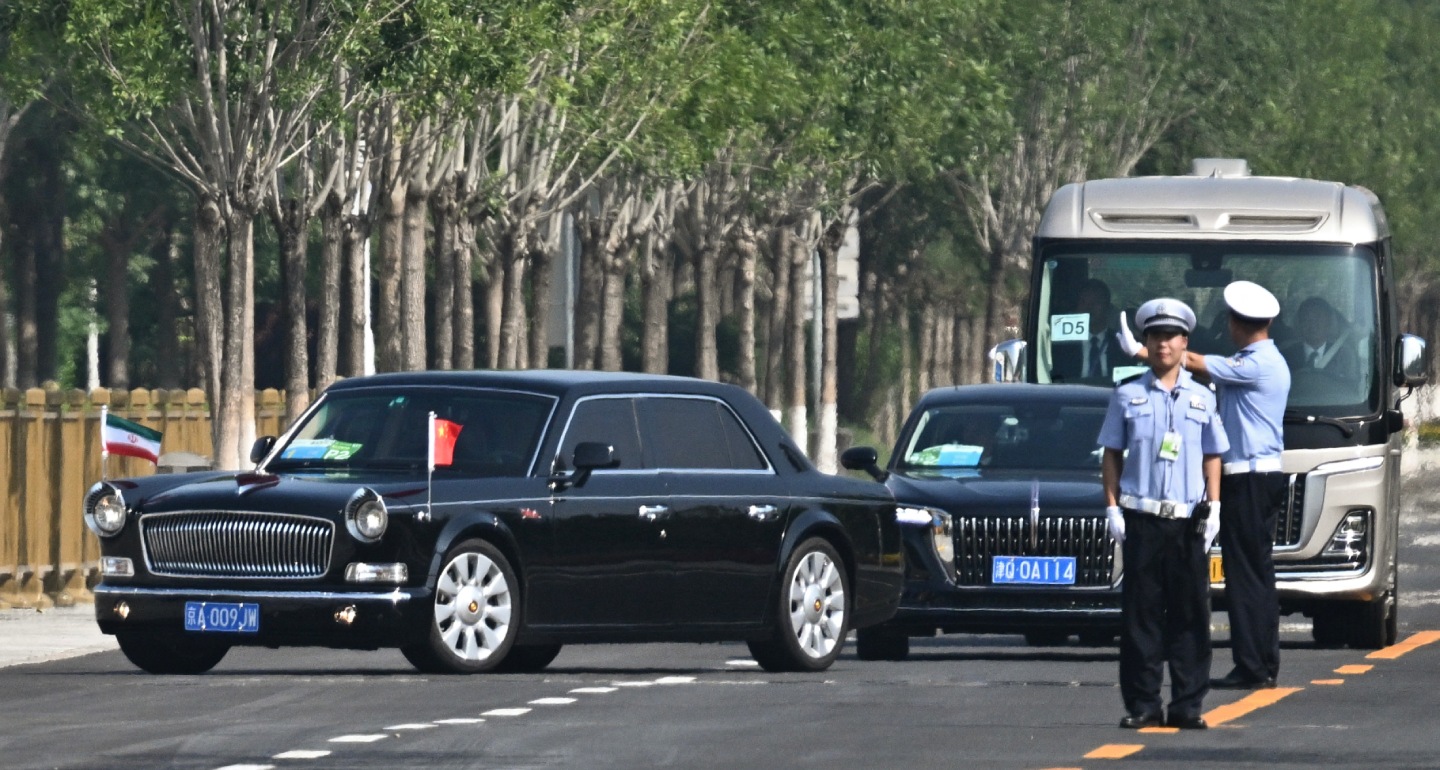
Source: Getty
Most of Moscow’s military resources are tied up in Ukraine, while Beijing’s foreign policy prioritizes economic ties and avoids direct conflict.
The regime in Tehran has been brought to the brink of collapse by just a few days of attacks by the United States and Israel. In this period, Iran would have benefitted immensely from help from its allies: particularly those from the authoritarian “CRINK” axis (China, Russia, Iran, and North Korea) that opposes the democratic world order.
However, neither Moscow nor Beijing has offered any tangible support, limiting themselves to public criticism of the United States and Israel. While Russia’s passivity can be explained by its preoccupation with the war in Ukraine, the expectation that China might prop up Tehran militarily has always been flawed. China is not the “new America,” and it has very different ideas of how to act effectively in the modern world.
Russia and China are indisputably Iran’s two biggest partners. Moscow and Tehran have become particularly close amid the war in Ukraine, with Western sanctions fostering the conditions for mutual cooperation. Since the full-scale invasion of Ukraine in 2022, the two countries have exchanged numerous high-level official visits, signed a strategic partnership agreement, and strengthened military ties.
Moscow has bought more than $4 billion worth of weapons systems from Tehran, mostly Shahed kamikaze drones. In return, Russia has sold Iran trainer jets, attack helicopters, armored vehicles, and rifles. Together, the two countries have been looking for ways to evade Western sanctions, and have also exchanged expertise on surveillance technologies. Iran signed a free trade agreement with the Russia-led Eurasian Economic Union in 2023.
Iran’s close ties with China began even earlier. On a tour through the Middle East in 2016, Chinese leader Xi Jinping made a state visit to Iran, during which the two nations signed a strategic partnership agreement. In 2021, they devised a twenty-five year plan under which Beijing promised to invest $400 billion in exchange for uninterrupted Iranian oil supplies.
Iran, Russia, and China have also developed trilateral cooperation formats. They have held regular joint naval exercises (known as Maritime Security Belt) since 2019, and often take the same position on global issues. Coordination became easier after Iran joined the international clubs led by Moscow and Beijing: the Shanghai Cooperation Organization in 2023, and the BRICS group of developing nations the following year.
Nevertheless, in Iran’s hour of greatest need, neither Russia nor China came to its
aid in a forceful, kinetic, and undeniable way. There have been reports that Moscow provided targeting data for U.S. warships and aircraft for Iranian strikes, which, if confirmed, could be seen as the Kremlin’s tit-for-tat response to massive U.S. intelligence assistance to Ukrainian self-defense over the last four years, which has contributed to the deaths of thousands of Russian military personnel.
No substantial assistance has materialized from the Chinese side yet—or at least, nothing comparable to Russia’s moves has been exposed by the U.S. government so far. Moscow and Beijing criticized Washington’s strike campaign and sought an urgent meeting of the United Nations’ Security Council—but these gestures were clearly incommensurate with the previous depth of the trilateral relationship.
For Russia’s part, all its modern S-400 air defense systems, aircraft, and missiles that could be of use to Iran are needed for the war in Ukraine. In addition, the Kremlin is still negotiating with Washington—and a standoff in the Middle East would jeopardize that process.
Some believe that since China is seeking to become the “new America,” it should have treated its Iranian allies like Washington treats its allies. However, times have changed. Back when the United States became a world leader, the situation was very different. The United States expanded its global role amid a Cold War standoff with the Soviet Union, which required the creation of a network of allies that could be rallied against a similarly clearly defined group of enemies. Washington had to win over new allies with tempting offers—including security guarantees.
That model doesn’t work today. The world is not divided into distinct camps anymore; processes unfold quickly and simultaneously; economies are intertwined; and technology facilitates interference in the domestic affairs of other states.
It’s too late for the United States to rescind the security guarantees it has handed out to its allies: that would inflict too much reputational damage. But China never provided such guarantees, and—observing the United States’ current difficulties—has no intention of starting now. Indeed, Beijing does not even officially use the term “ally,” preferring “friendship without limits” or “all-weather strategic cooperation.”
It’s not the first time China has refrained from rushing to the aid of strategic partners in distress: Beijing was conspicuously absent for Russia in Ukraine, President Nicolas Maduro in Venezuela, and Pakistan in its conflict with the Taliban in Afghanistan. But this is not a sign of weakness. Military support for friendly regimes has never been part of China’s strategy for global leadership.
Diversification is also a pillar of Chinese foreign policy. While Beijing values its ties with Iran, it has other important partners in the Middle East, such as Saudi Arabia, which supplies more oil to China than Iran. Beijing’s Belt and Road Initiative is being integrated with Riyadh’s Vision 2030, and the two countries subsequently signed a $50 billion agreement.
The trade turnover between China and some Arab states—like the United Arab Emirates—is almost ten times the volume of China’s trade with Iran. China also works closely with companies from other Gulf monarchies: for example, it is cooperating with Saudi firm ACWA Power to develop a $1 billion solar energy project in Uzbekistan.
All these joint projects (as well as significant ties with Israel) would be threatened if China rushed to provide military assistance to Tehran, particularly given the fervor with which Iran is currently bombing its Persian Gulf neighbors.
Finally, U.S. President Donald Trump is due to visit Beijing in April: the first visit by a U.S. leader for nearly a decade. No breakthroughs are expected, but it will be symbolically important. China does not want to scupper relations with the United States because of Iran.
Right now, Beijing’s priority is to survive Trump’s presidency without a major trade war or some other escalation. Of course, China will also quietly seek to solidify its advantage when it comes to rare earth metals mining, gain as much as know-how as possible from Western technology while it still has access, and double down on import substitution (which was given particular priority in the 2026–2030 five-year-plan).
Even if the Iranian regime does not survive the U.S.-Israeli bombardment, its successor will have no choice but to engage with China, which holds a monopoly on the delivery of high-tech goods and is the main buyer of Iranian oil. It will always be far easier for Beijing to find a different supplier (for example, Russia), than it would be for Iran to find new buyers. Not to mention that Iranian oil supplies to China will become less important for China as it develops alternative energy sources.
Given all this, China has absolutely no reason to get involved in an unpredictable regional war. It makes far more sense for Beijing to sit on the sidelines, consolidate its position, and avoid wasting resources on peripheral concerns.

Director, Carnegie Russia Eurasia Center
Alexander Gabuev is director of the Carnegie Russia Eurasia Center. Gabuev’s research is focused on Russian foreign policy with particular focus on the impact of the war in Ukraine and the Sino-Russia relationship. Since joining Carnegie in 2015, Gabuev has contributed commentary and analysis to a wide range of publications, including the Financial Times, the New York Times, the Wall Street Journal, and the Economist.

Fellow, Carnegie Russia Eurasia Center
Temur Umarov is an expert on China and Central Asia, and a fellow at the Carnegie Russia Eurasia Center.
Carnegie does not take institutional positions on public policy issues; the views represented herein are those of the author(s) and do not necessarily reflect the views of Carnegie, its staff, or its trustees.
The interventions in Iran and Venezuela are in keeping with Trump’s strategy of containing China, but also strengthen Russia’s position.

Mikhail Korostikov
For a real example of political forces engaged in the militarization of society, the Russian leadership might consider looking closer to home.

James D.J. Brown
China has found a unique niche for itself within the global security ecosystem, eschewing military alliances to instead bolster countries’ internal stability using law enforcement. Authoritarian regimes from the Central African Republic to Uzbekistan are signing up.
Temur Umarov
The supposed threats from China and Russia pose far less of a danger to both Greenland and the Arctic than the prospect of an unscrupulous takeover of the island.

Andrei Dagaev
In Central Asia, Beijing is learning to adapt. The era of raw economic assertiveness is giving way to a more nuanced strategy that fuses investment with education, infrastructure with human capital, and ambition with a dose of humility.

Edward Lemon, Bradley Jardine