

Commentary
Michael Young
{
  "authors": [
    "Michael Young"
  ],
  "type": "commentary",
  "blog": "Diwan",
  "centerAffiliationAll": "",
  "centers": [
    "Carnegie Endowment for International Peace",
    "Malcolm H. Kerr Carnegie Middle East Center"
  ],
  "collections": [
    "Syria in a New Era"
  ],
  "englishNewsletterAll": "",
  "nonEnglishNewsletterAll": "",
  "primaryCenter": "Malcolm H. Kerr Carnegie Middle East Center",
  "programAffiliation": "",
  "programs": [],
  "projects": [],
  "regions": [
    "Syria"
  ],
  "topics": []
}
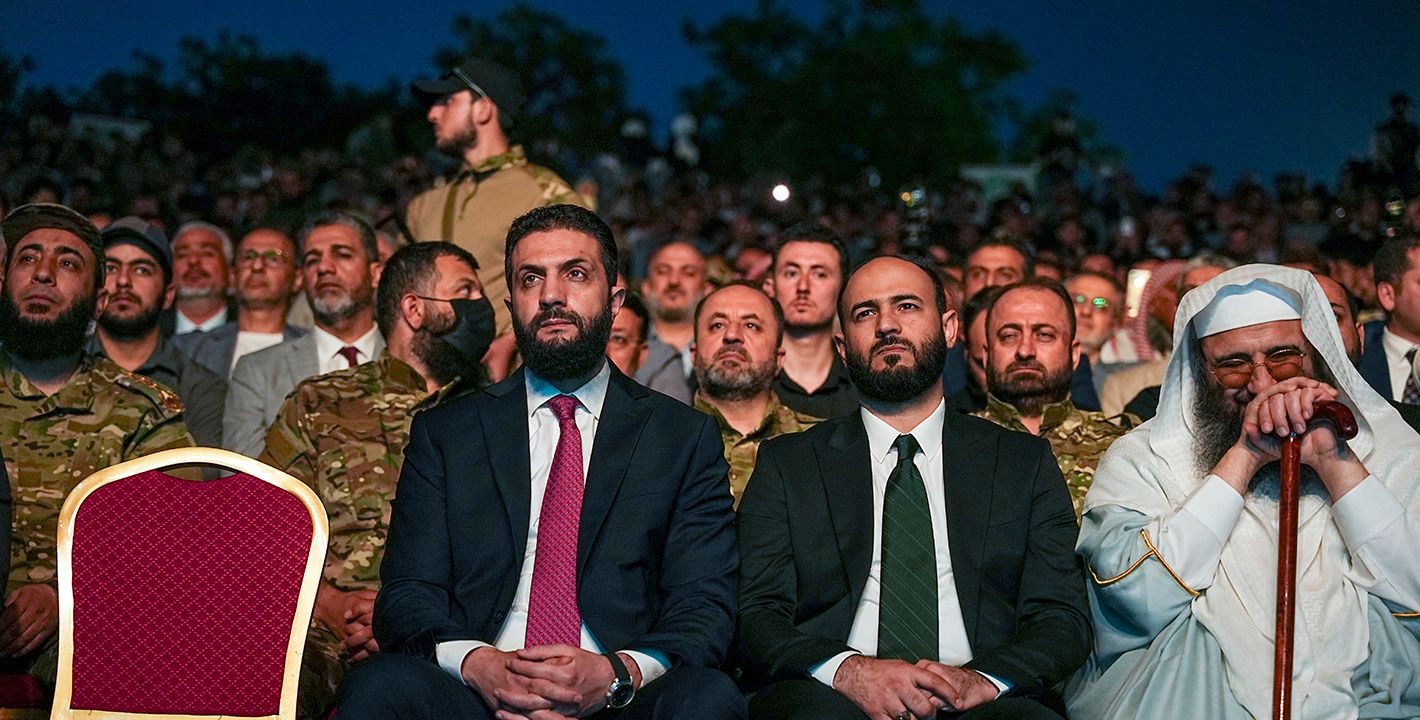
Source: Getty
In an interview, Haddon Barth discusses his doubts about the Syrian regime’s approach to national reconstruction.
Haddon Barth is a freelance writer and history student at Princeton University, who has engaged in research on Syria and Iraq. He has written for Foreign Policy, Lawfare, and L’Orient Today, and has focused lately on the transition in Syria, in particular the reconstruction process, by closely examining open source information. Previously, he supported research efforts at UN Migration in Jordan and International IDEA in Tunisia. Diwan interviewed him in late September to discuss his findings on the reconstruction process in Syria, but also its discontents.
Michael Young: You have been following Syria’s reconstruction process closely through open-source information. What are your main worries about i?
Haddon Barth: In the aftermath of Bashar al-Assad’s downfall, Syria now faces a narrow window in which the choices made will determine the shape of its economy for years to come. Critical questions hang in the balance: To what extent will public industries be privatized? How transparent will the management of public wealth be? Will foreign investors be able to rely on Syrian courts to uphold their agreements?
My biggest concern is that these questions are being answered behind closed doors, and so far, the answers mainly serve the interests of the transitional authorities. Syrian President Ahmad al-Sharaa’s reorganization of the Syrian economy appears to be recreating the kleptocratic patterns entrenched under his predecessor, in which regime insiders enriched themselves under a different set of rules than those applied to the Syrian public.
MY: Last July, the Syrian authorities announced the establishment of a sovereign wealth fund, which you’ve written about in L’Orient Today, for example. What is it about the fund that you have found most surprising, and most troublesome?
HB: The creation of a sovereign wealth fund was, for me, the first major red flag. The fund is entirely managed by Sharaa’s inner circle. He chairs it himself, appointed the seven-member board by presidential decree, and handpicked the general manager, who serves as the fund’s legal representative and financial officer. The oversight that does exist is nominal: the auditors report directly back to Sharaa, bypassing the Finance Ministry, the body traditionally tasked with managing public wealth.
The fund’s financing is also murky. No one knows for sure where its initial capital will come from. The founding decree cites several sources, but half are future gains from the fund, not sources of seed funding, and the remaining two—“state allocations” and “grants”—are undefined catch-alls broad enough to encompass any possible asset placed in the fund. We cannot yet know how the fund will ultimately be used. What experts in sovereign wealth funds emphasized to me, however, is that such funds provide a convenient mechanism for legitimizing illicit revenues by folding them in as start-up capital. And once the fund is capitalized, the absence of oversight would make it easy for resources to be diverted to Sharaa’s inner circle.
MY: On August 6, Sharaa, announced twelve investment deals worth $14 billion. This would appear to be a major example of progress, yet in looking more closely at it, you had certain questions. Can you share what you discovered?
HB: A number of these investing partners are shell companies. The most glaring example is Ubako Ascensori, which agreed to invest $2 billion in the construction of the Damascus Towers Project. Ubako has a single employee, self-reported annual revenues of just €216,000, and was only founded three years ago. Its website, created three months before the deal, leans heavily on AI-generated promotional videos and is riddled with basic errors. It boasts, “We Are Leading International Company in the World,” claims expertise in “Land Minning” and “Conslutancy,” and even bungles its office hours. One generic blurb promises that “[Company Name] has been combining decades of expertise with cutting-edge technology since [Year].” Nothing in Ubako’s profile suggests it could deliver an investment of $2 billion in Syria.
Also, among the companies in the deal to renovate Damascus International Airport is the Turkish firm Polidef, which advertises partnerships with Turkish defense giants Acelsan and Havelsan. However, no evidence from those companies substantiates these claims. Its purported offices in Istanbul and Ankara show no visible signs of activity and no executives can be traced through registries or LinkedIn. The company’s website is built from a generic WordPress template.
Why stage such agreements? The most straightforward explanation is optics, giving the impression that Syria is attracting outside capital. Alternatively, government officials may have received kickbacks for promoting the companies, or used memorandums of understanding to provide cover for reassigning development rights to insiders. It is possible, too, that Sharaa’s government was genuinely duped, mistaking these entities for legitimate partners. But that seems unlikely given the shrewdness the authorities have otherwise displayed.
MY: Assuming certain announcements by the Syrian authorities were designed to create an impression of momentum in reconstruction financing, is this so unusual, or reprehensible, in the circumstances that Syria faces? Confidence is the first thing that Damascus needs to rebuild after years of war, no?
HB: In principle, the idea is sound. Sharaa inherited from Assad a distorted economy built on patronage and rent extraction, one that enriched a small circle of people while leaving the vast majority of Syrians surviving day-to-day. Rebuilding that economy requires rebuilding foreign investor confidence in institutions.
Some of Sharaa’s steps do point in that direction. Sovereign wealth funds can, for example, attract capital to frontier economies by co-investing in infrastructure projects and reducing political risk. Announcing major investment deals can also serve as a signaling mechanism, suggesting that others have already judged Syria worth the risk.
But attracting foreign capital depends on trust. A sovereign wealth fund with opaque governance and unclear financing will drive investors away rather than reassure them. Announcements involving shell companies will increase perceptions of risk.
MY: How have the new Syrian authorities dealt with the Assad-era business class, and how do you think this fits into the strategy of the new leadership in Damascus when it comes to the economy?
HB: This was the central question facing the new authorities when they took power. Under Assad, the economy was dominated by two pillars: a network of moguls who monopolized major sectors by cutting deals with Assad; and the palace’s own corporate empire. That empire comprised more than a hundred companies spanning airlines, telecommunications, real estate, and was supplemented by a deep entanglement in the Captagon trade. The dilemma for Sharaa was what to do with those industries and businessmen. His answer, as a Reuters investigation revealed, was to create a secret committee headed by his brother Hazem to claw back assets from Assad-era businessmen. Rather than prosecute them in court, the committee negotiated settlements: an amnesty in exchange for cash and equity stakes. In just months, it reclaimed more than $1.6 billion. Prominent figures surrendered large portions of their empires, from sugar refineries to steel plants and shares in airlines.
This system now provides Sharaa with a ready pool of resources. In the best-case scenario, the committee would be made public and the wealth placed under transparent control. In the more likely one, the wealth will be used for a variety of projects, including capitalizing the new sovereign wealth fund. In that case, publicly undisclosed assets stripped from Assad-era magnates will be laundered in a “public” institution run by Sharaa’s closest allies, easily leveraged to enrich insiders and sustain patronage networks.
The consequences of these seizures are far-reaching. If the state has decided to circumvent the judiciary—a decision justified by committee members on the grounds that it does not trust Assad-era judges—investors won’t trust it either, nor trust that their contracts won’t be coercively renegotiated by the Syrian government.
MY: You touched upon what is required for Syria to better reassure foreign, particularly Western, investors in its massive reconstruction effort. More specifically, however, what are the prerequisites for a successful reconstruction endeavor in the country?
HB: The decisive factor is credibility. Ultimately, no matter how many deals Sharaa announces, investor confidence depends on faith in the rule of law. Investors often enter high-risk environments, but only if they trust that contracts will be honored and disputes adjudicated fairly. That means restoring confidence in the courts and ensuring transparent management of economic institutions, beginning with reforming the sovereign wealth fund and the asset-recovery committee. Syria’s sovereign wealth fund could be pivotal for the country’s reconstruction. Globally, funds like these help crowd-in foreign capital by anchoring projects and de-risking them, absorbing first losses or capping state returns so private partners see more upside. Syria’s wealth fund has the potential to do the same, but, as structured today, it risks deterring investment more than mobilizing it.
The United States has a role to play here as well. Sharaa’s appearance at the United Nations General Assembly last week was driven in part by hope for further sanctions relief through repeal of the Caesar Act. If Washington moves in that direction, it should condition any repeal on greater transparency of both the sovereign wealth fund and the asset-recovery committee. As it stands, the trajectory is troubling: an economy consolidating under opaque, family-centered management that looks strikingly similar to the crony capitalism of Assad’s final years.

Editor, Diwan, Senior Editor, Malcolm H. Kerr Carnegie Middle East Center
Michael Young is the editor of Diwan and a senior editor at the Malcolm H. Kerr Carnegie Middle East Center.
Recent Work
Michael Young
Michael Young
Carnegie does not take institutional positions on public policy issues; the views represented herein are those of the author(s) and do not necessarily reflect the views of Carnegie, its staff, or its trustees.
A recent offensive by Damascus and the Kurds’ abandonment by Arab allies have left a sense of betrayal.
Wladimir van Wilgenburg
The government’s gains in the northwest will have an echo nationally, but will they alter Israeli calculations?

Armenak Tokmajyan

The country’s leadership is increasingly uneasy about multiple challenges from the Levant to the South Caucasus.
Armenak Tokmajyan
Recent leaks made public by Al-Jazeera suggest that this is the case, but the story may be more complicated.
Mohamad Fawaz
The U.S. is trying to force Lebanon and Syria to normalize with Israel, but neither country sees an advantage in this.
Michael Young